Marvel Rivals: What Jay3's Lose-and-End Challenge Reveals About the Game
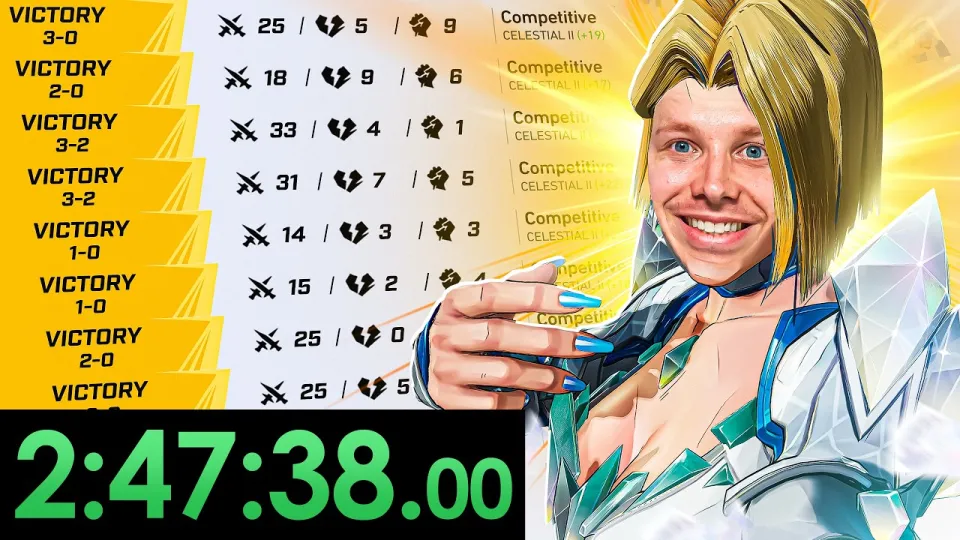
Video: IF I LOSE, THE VIDEO ENDS... (Marvel Rivals)
Want articles like this for your own video to promote it on YouTube and Google? Order them through the Telegram bot @sat_sit_bot. It writes articles around your video, embeds the video and publishes them on popular niche websites (no ads). Free trial — 50 articles.
Marvel Rivals is a free-to-play 6v6 hero shooter in which destructible terrain and team-up abilities decide most fights, and Jay3's lose-and-end challenge turns that volatility into a countdown: the first defeat stops the video. The format is simple — win every match or the run is over — and it exposes exactly how quickly a Rivals game can flip on one bad team fight. You can watch Jay3 live and catch the next challenge as it happens on his Twitch channel.
What the lose-and-end format actually tests in Marvel Rivals
The challenge is a stress test of decision-making, not aim. In a game where a single ultimate can wipe a payload push, the player who treats every round as the last one plays differently: fewer greedy flanks, earlier swaps, more patience on defense.
- Hero picks get conservative. Comfort picks and reliable team-up partners come first.
- Ult economy becomes the priority. Holding a support ultimate for the enemy Storm or Iron Man dive matters more than chip damage.
- Communication tightens. Callouts on destructible walls and flank routes replace solo plays.
- Losses feel heavier. One bad match ends the run, so a single thrower or a disconnected teammate is fatal.
That is also why the format suits Marvel Rivals better than a pure highlight reel: the game's comeback potential is real, but so is its collapse potential, and both are visible inside a single match.
How Marvel Rivals plays: roles, team-ups, and destructible maps
Marvel Rivals splits its roster into Vanguard, Duelist, and Strategist roles, and the team-up system rewards specific pairings with bonus abilities. A 6v6 lobby lives or dies on composition: two Vanguards to hold space, two Strategists to sustain, and Duelists who can actually finish kills.
Destructible environments add a second layer. Walls and cover can be removed, which means a safe angle in one round is gone in the next. Teams that rebuild their positioning after a section of the map is destroyed keep pressure; teams that don't get picked apart from open sightlines. This is the mechanical reason a match can swing so fast, and it is the reason a must-win challenge is genuinely tense rather than scripted.
The ranked reality behind the video
Ranked Marvel Rivals is where the challenge gets complicated, and the audience knows it. The most common complaint under videos like this one is not about skill gaps but about teammates: players locking a role they don't main, Vanguards teleporting the team into the wrong spot, or a Jeff and a Squirrel Girl deciding a match is already lost.
That frustration is legitimate, but it points at a real skill: adapting to a lobby you didn't choose. In a must-win format, the counter is not complaining about the off-role Duelist — it is picking a hero that covers the gap. If your team has no reliable dive, play the anti-dive. If your Strategists keep dying first, peel instead of pushing. A challenge run rewards the player who treats teammates as fixed conditions rather than problems to solve in chat.
Typical questions from viewers, answered by the gameplay
Three themes come up again and again in the comments, and each has an answer visible in the matches themselves.
- "Why does he keep playing the same hero?" Because consistency beats variety when a single loss ends the run; a known cooldown and ultimate charge time is worth more than a surprise pick.
- "Isn't this just luck with teammates?" Partly — matchmaking variance is real — but the challenge measures how often a strong player can convert a mediocre lobby, and that number is higher than most viewers expect.
- "Why so much screaming?" Close fights in Rivals are loud by design: sudden ultimate chains, last-second support saves, and one-shot picks produce genuine reactions, and the clip-friendly moments are the point of the format.
- "Where is the Overwatch content?" Jay3's background is Overwatch, and viewers regularly ask for it back, but Marvel Rivals offers a different sandbox — 6v6 with destructible cover — that his Grandmaster habits translate into quickly.
Where to follow Jay3 and the rest of his channels
Jay3 streams live on Twitch and runs a family of YouTube channels covering main uploads, gameplay, variety, VODs, and IRL content, plus social accounts for clips and community updates.
- Twitch (live streams): https://twitch.tv/jay3
- Twitter: https://twitter.com/jay3ow
- TikTok: https://tiktok.com/@jay3twitch
- Instagram: https://instagram.com/jay3twitch
- Discord community: https://discord.gg/jay3
Conclusion: why the challenge format fits Marvel Rivals
A lose-and-end run works because Marvel Rivals gives every match enough swing to make the stakes believable — destructible maps, team-up bonuses, and ultimate chains can erase a lead in seconds. Jay3's version of the challenge leans on his Grandmaster Overwatch background: disciplined picks, patient ultimate usage, and the willingness to adjust to whatever lobby he gets. The result is a compact lesson in how the game punishes sloppy decisions and rewards adaptation. If you want to see the next run live rather than edited, follow Jay3 on Twitch and catch the stream as it happens.
Key takeaways
- Jay3's Marvel Rivals challenge ends the video the moment he loses a single match, turning every game into a must-win.
- Marvel Rivals is a free-to-play 6v6 hero shooter built on destructible environments and team-up abilities between heroes.
- Jay3 is a Grandmaster-level Overwatch player who moved part of his content to Marvel Rivals.
- Viewer feedback on the video centers on ranked frustration: throwers, off-role teammates, and one-sided matches.
- The challenge format works because Marvel Rivals matches swing hard on team composition and ultimate economy.
Questions & answers
What is the lose-and-end challenge in Marvel Rivals?
It is a video format where the creator keeps playing until the first loss, at which point the video ends. In Marvel Rivals this is tense because a single ultimate chain or a thrower teammate can decide a match, so every round carries real risk.
Is Marvel Rivals free to play, and what roles does it use?
Yes, Marvel Rivals is free to play. Its roster is split into Vanguard, Duelist, and Strategist roles, and teams are 6v6. Team-up abilities between specific heroes and destructible environments are the two systems that most shape how a match plays out.
Why do so many ranked Marvel Rivals games feel lost in matchmaking?
Ranked frustration usually comes from teammates playing off-role, poor ultimate coordination, or players giving up early in a match. Those factors are real, but the practical response is to pick a hero that covers the team's gap rather than to argue in chat.
Who is Jay3 and why does he play Marvel Rivals?
Jay3 is a Grandmaster-level Overwatch player and streamer who also covers Marvel Rivals. His background in 6v6 hero-shooter fundamentals — ultimate tracking, positioning, role flexibility — transfers directly to Rivals, which is why challenge formats suit his content.
Source: IF I LOSE, THE VIDEO ENDS... (Marvel Rivals) · Markdown version